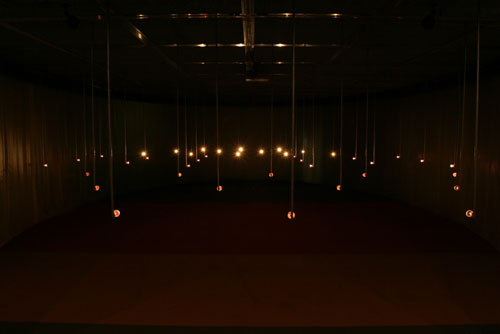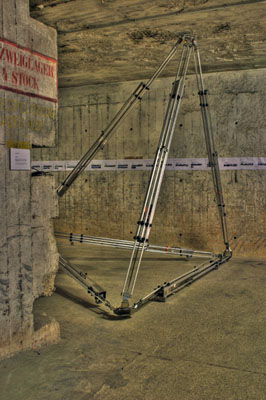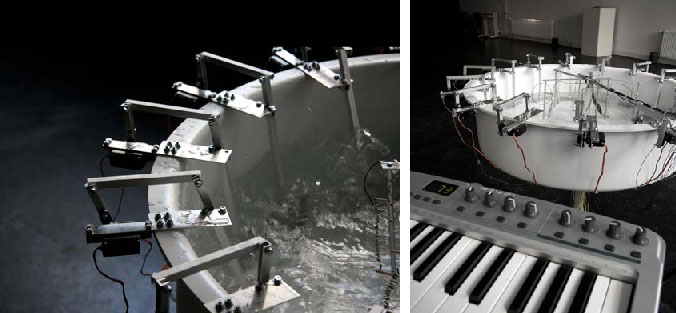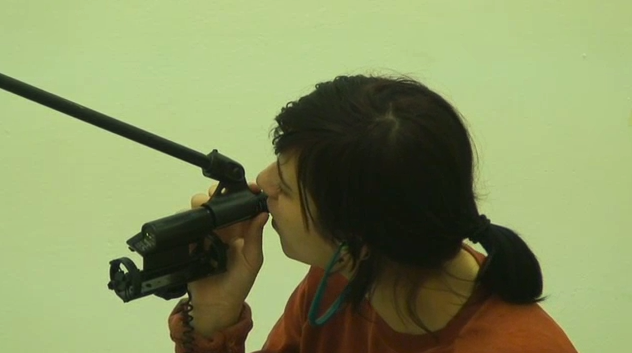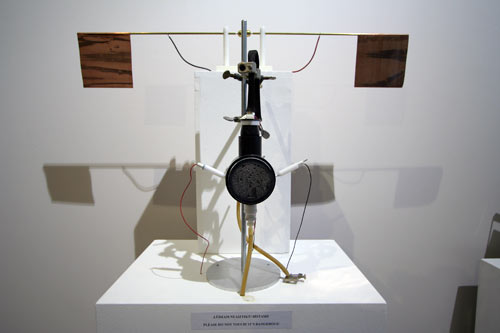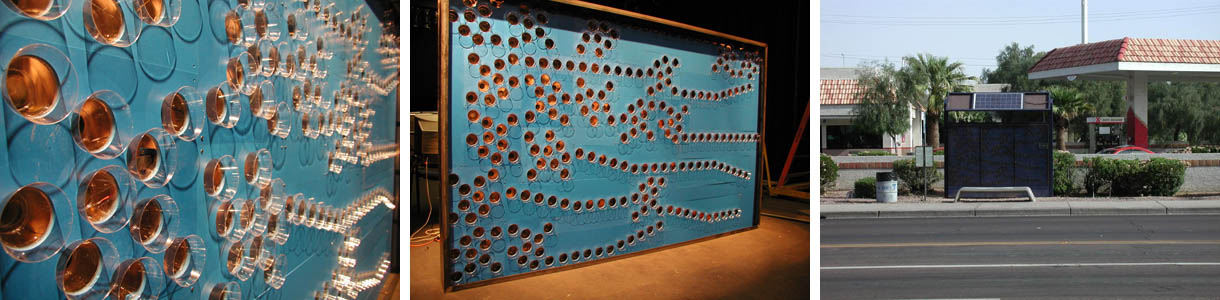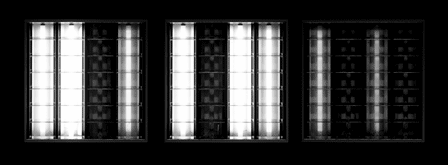
“Tempest”, 2004 by Erich Berger.
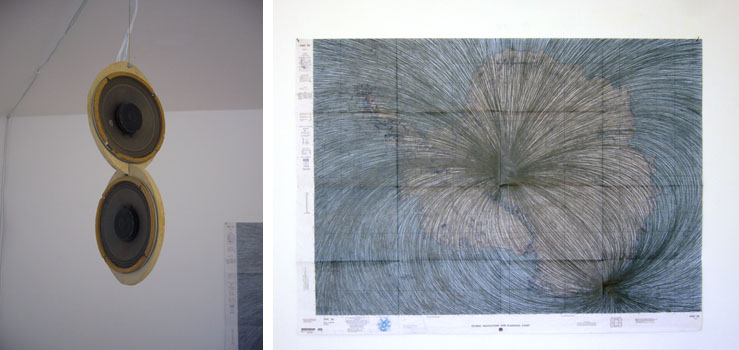
A sound piece monitoring the live magnetic field of the house and drawings from the “Magnetic” series by Justin Bennett.
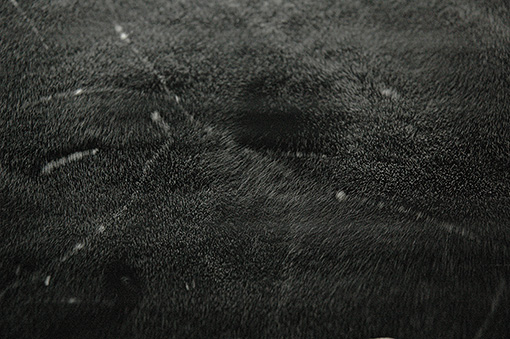
»Traces«, 2007. The Traces series is a number of 14 photographs that document the numerous traces of cosmic and terrestrial radiation, which ionize the gaseous ethanol steam inside a cloud chamber.
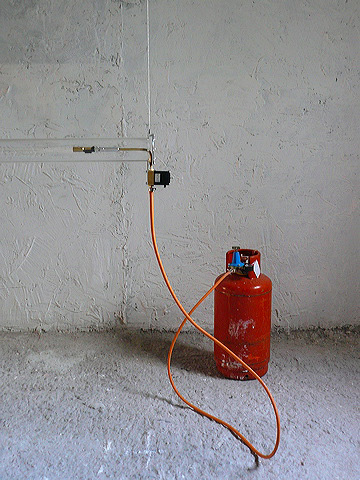
»334 m/s«,2007, is a room installation, which is meant to visualize the speed of sound (c = λ ⋅ ƒ), which is about 334 m/s. Two translucent tubes are filled with propane gas, which is set on fire to cause a chain reaction. A flame is burning from one side to the other, slowly accelerating to the point where it hits the end of the tube. Due to the ratio of the gas-oxygene mix the flame there causes a rapid explosion, which can be heard as a sonic boom. By Carsten Nikolai.
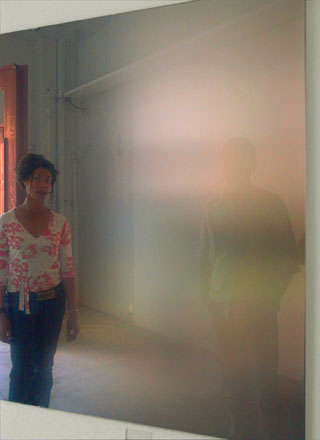
“Driftglass” (interactive series of optically deceptive mirrors with sonic feedback
mirror, optic film, proximity sensors, audio components). Seeing clear reflections of others, viewers find their own image diffused. By Camille Norment.

A bag of live »Snails« with a properly protected microphone introduced in its core. The resulting sound is amplified in the same room as the bag is standing. By Fernandes Avelãs.
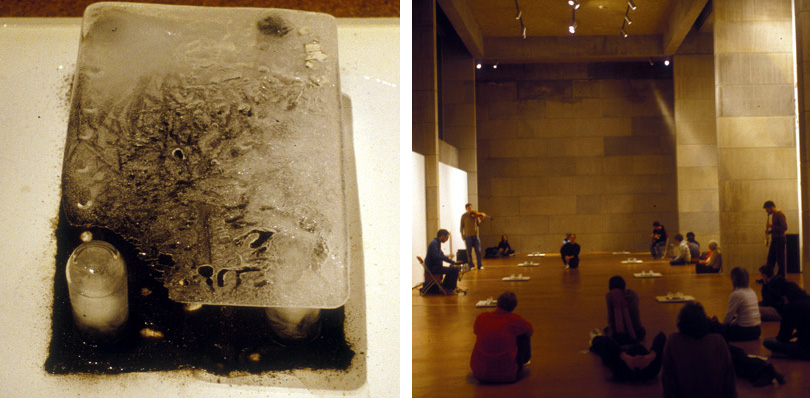
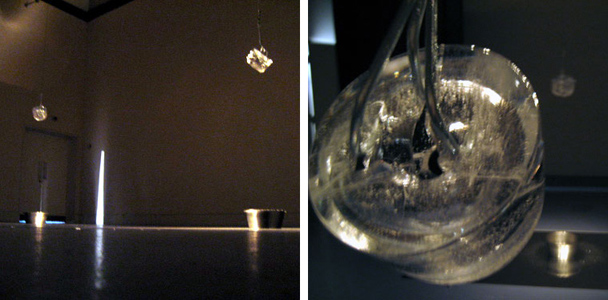
“Distillation”, an installation with amplified sheets of melting ice by Dan St. Clair.
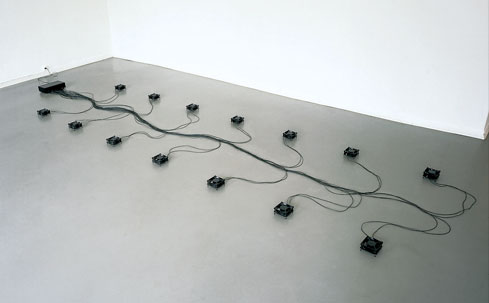
»Wind-drawing«, 1995. The ventilators are started one after the other forming pillars of wind rising up vertically from the floor.
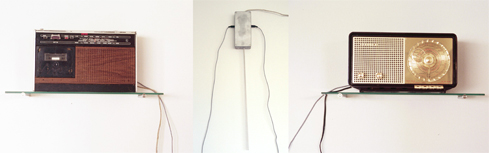
»Conversation«, 2001. An electronic metronome swings with a certain Interval between the radio stations of two countries and alter nately cuts and reinstates electricity. By Finnbogi Petursson.
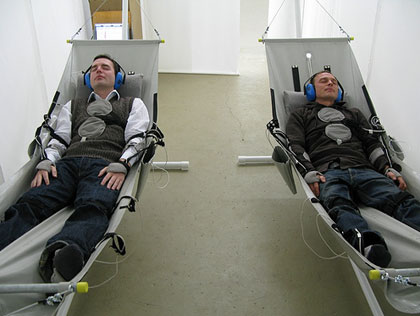
Sound installation “Raplapla” by Lynn Pook. Fourteen loudspeakers are positioned in a hammock, touching different parts of the extended body. In this way, the vibrations from the loudspeakers become manifest and the sounds are carried, via the bones, to the inner ear.
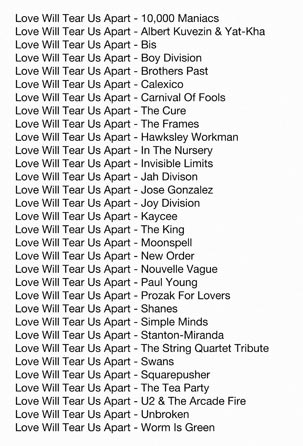
“All together now” – Playlist and
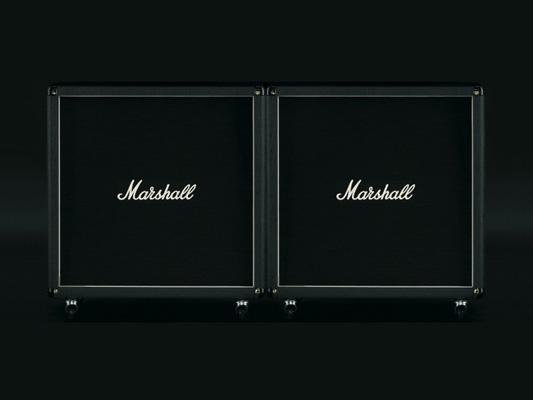
“Pair of speakers, audio” – Audio installation in which Marshall & Marshall emit popular duets performed by famous ‘couples’. By Jack Falanga.
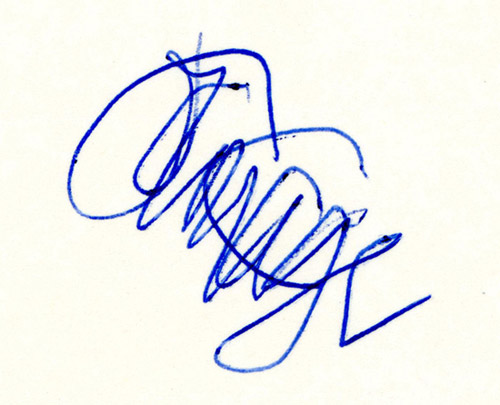
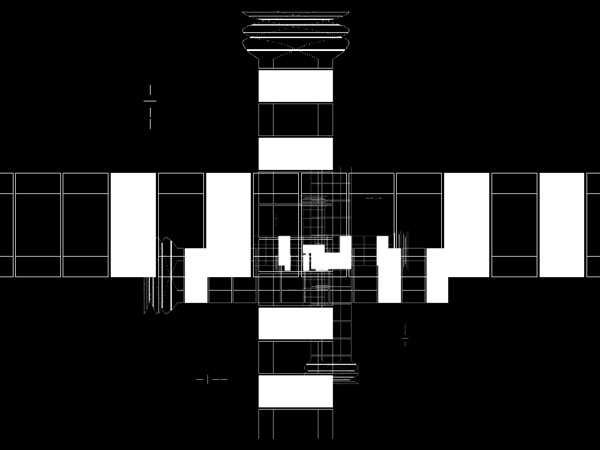
In “The John Cage Autograph” RGB values of the image are converted to chromatic scale piano sounds. By Steffen Kasperavicius.